
Plus size care: key for today’s health and social care providers
In 2022/23, there were over 1.2 million hospital admissions in England where obesity was a factor—up from 1.14 million in 2021/22. This equates to around 3,000 admissions per day, a significant increase from 2016/17 figures[2]. The cost of obesity to the NHS was estimated at £6.5 billion in 2022, up from £6.1 billion in 2018/19[3]. By 2040, it is projected that 71% of UK adults will be overweight or obese, with over 21 million adults (36%) expected to be obese. This projection aligns with earlier estimates that around 70% of adults could be overweight or obese by 2034[4].
Caring for overweight or obese people is a key element for today’s health and social care providers[5], placing considerable pressure on available resources[6][7].
Terminology
When referring to the individual person, the term plus size is the preferred terminology as the word bariatric is the branch of medicine that deals with the causes, prevention, and treatment of obesity and does not encompass the individual’s holistic needs[6].
Definition
Definitions, which focus solely on weight fail to allow for the fact that people are affected differently by excess weight, dependent on body shape[8], which impacts on equipment needs[9], space required and activities of daily living[9].
Patients are considered morbidly obese when they have a body mass index (BMI) of 40 kg/m², or greater than 35 kg/m² with at least one serious obesity-related condition, or being more than 45kgs over ideal body weight[10].
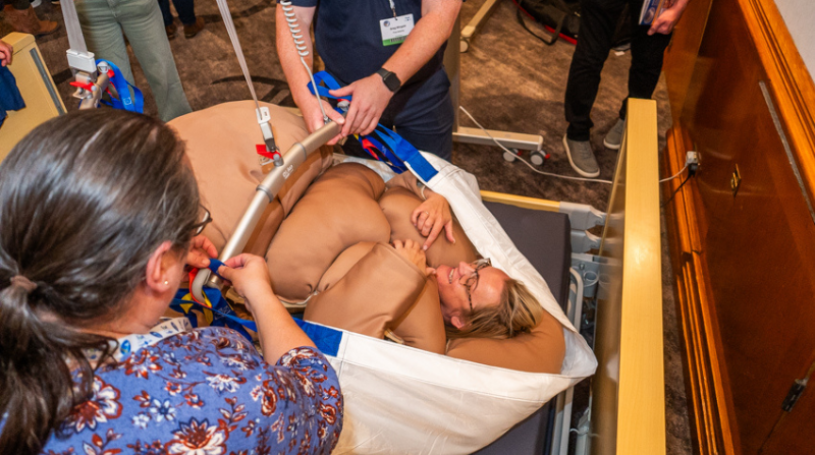
To find out more read the Moving and Handling of Plus Size People – an illustrated guide that promotes solutions, which can be applied within a variety of health and social care settings. The guiding principles behind the publication is to promote independence and provide the reader with information that supports them in their everyday practice. The publication promotes a culture of harm-free care and fosters an integrated person-centred approach. The route to delivering quality care begins by predicting the challenges and then implementing, monitoring and evaluating risk reduction activities.[11]
[1] World Health Organisation (May 2025) Obesity and Overweight Obesity and overweight Accessed October 2025
[2] Diabetes co.uk NHS deals with 3,000 hospital admissions each day due to obesity Accessed October 2025
[3] NHS England Digital (2024) Health Survey for England 2022 Part 2 Adult overweight and obesity - NHS England Digital Accessed October 2025
[4] Cancer Research UK (2022) New Analysis over 21 million adults will be obese by 2040. New analysis estimates over 21 million UK adults will be obese by 2040 - Cancer Research UK - Cancer News Accessed October 2025
[5] Muir, M, Archer-Heese, G. (2009) Essentials of Bariatric Patient Handling Program, OJIN: The Online journal of Issues in Nursing Vol. 14, No. 1
[6] Muir, M A and Rush, J A (2013) Moving and Handling of Plus Size People an illustrated guide, Towcester: National Back Exchange, 9 2019
[7] Cawley, J. and C. Meyerhoefer, The medical care costs of obesity: an instrumental variables approach. J Health Econ, 2012. 31(1): p. 219-30.
[8] Corbyn C, Rush A (2010) Challenges of wound management in bariatric patients. Wounds UK 6(4): 62–71
[9] Swann J (2013) Understanding the difference between overweight, obese and bariatric. J Paramedic Pract5(8): 436–41
[10] https://obesitymedicine.org/what-is-morbid-obesity/Accessed October 2025
[11] Hignett S and Griffiths P (2009) Manual handling risks in the bariatric (obese) patient pathway in acute, community and ambulance care and treatment. Work 33(2), 175